Tampilkan postingan dengan label Role Models. Tampilkan semua postingan

Cultural Criticism: Misogyny or Disdain?

ADSENSE HERE


In the above Twitter thread, famed Young Adult fiction author John Green decries our society’s overwhelming scorn of Stephanie Meyer’s Twilight books.
While he makes a few valid points—for example, that it’s easy “to dehumanize the creator or fans of something extremely popular” and that we could probably find something better to satirize than “unironic love stories”—I take issue with his suggestion that just because a lot of people didn’t read any misogynistic undertones into the series, we should refrain from criticizing it.
Tens of millions of people might not have found anything wrong with the relationships Meyer included in Twilight, but that does not mean that those of us who noticed a problem should simply silence ourselves and allow a popular book to perpetuate harmful messages.
To answer Green’s question about whether our disdain for Meyer’s works might be more misogynistic than the stories’ content: NO. It’s not more misogynistic, simple as that. Misogynisticcan be defined as “reflecting or exhibiting hatred, dislike, mistrust, or mistreatment of women.” We can disagree with a woman and disapprove of her work without allowing that opinion to color our feelings or treatment toward women in general. Sure, some of those who criticize Meyers may be misogynistic about their approach, but as long as we provide constructive and respectful commentary, we should be free to express a dissenting opinion. Criticism does not imply misogyny.
It is oversimplified logic like Green’s that allows discrimination and other damaging behavior toward women (or other oppressed groups) to continue. Majorities can quite easily find themselves in the wrong: if those disagreeing with the majority never spoke up, society might never have made the same leaps and bounds toward equality that we have in recent decades.
Now, I’m not saying that we should avoid any piece of art or media that includes offensive content. (We might never watch another movie again if we tried to follow that rule.) We should enjoy stories that touch our hearts, but also recognize that no story is perfect. Recognizing the flaws in our books and movies and songs and paintings will help foster a more productive conversation about how we might change ourselves—and our world—for the better.
ADSENSE HERE
Body Love: Are You Happy in Your Own Skin?

ADSENSE HERE
Loving your body can be tough. Poor body image has many negative outcomes—it contributes to depression and eating disorders, undermines self-confidence, and inhibits sexual expression. When we feel unattractive, we are more fearful of negative evaluations from others and develop shame. Such shame leads to self-disrespecting behavior such as chronic dieting, overeating, compulsive exercising, and other forms of purging. While body image tends to have very little correlation with how you actually look (beautiful women are as likely as plain to be unhappy with their looks), there are strong links to negative body image and low self-esteem.

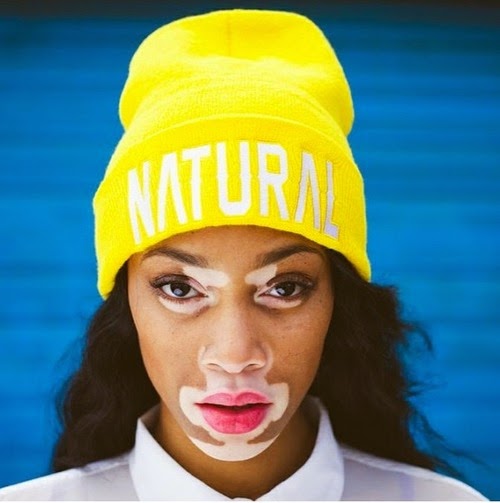
As I was doing research on this topic, I came across a YouTube video about a young woman, Chantelle Brown, who has a rare skin condition and pigment disorder called vitiligo, in which the skin’s pigment cells are destroyed. As a result, white patches appear on the skin in different parts of the body.  

"A lot of people have a story and a background, but mine is painted on my body,” Chantelle says. Chantelle, whose vitiligo began to materialize at age four, grew up being bullied and called names such as “cow” and “zebra.” She struggled with her self-esteem and—at her lowest point—pondered suicide. Despite her struggles, she has learned to love her body and herself: "I have my flaws but I embrace them." See her interview in the video below!

How would you like to love your body and yourself like Chantelle? How would it feel to embrace your flaws as beautiful, rather than hiding them and tearing yourself down?
ADSENSE HERE

Women in Art History: Artemisia Gentileschi

ADSENSE HERE


Artemisia Gentileschi was among the most accomplished Italian Baroque painters during a time when women were rarely even acknowledged by the art community. Gentileschi became the first woman accepted into the Florence Academy of Fine Arts and remains well known for portraying Biblical and mythological women as strong protagonists instead of stereotyped objects. She even depicted herself as a working artist in Self Portrait as the Allegory of Painting (1638-39). Despite being a masterfully executed Baroque work, this self portrait was controversial as it was not generally acceptable for women to hold jobs, especially in the male-dominated field of painting. In addition to defying societal norms and sharing her remarkable talent, Gentileschi also survived an assault and even participated in the prosecution of her attacker at the risk of her reputation.
ADSENSE HERE

Ban Bossy?

ADSENSE HERE

Ban Bossy is a campaign by Girl Scouts of America and LeanIn.org. Strong women and leaders, including Beyoncé, Condoleezza Rice, and Jane Lynch, all support the campaign.

The campaign is to encourage girls and help them develop leadership skills. Women make up just nineteen percent of the U.S. Congress, five percent of Fortune 1000 CEOs, and seventeen percent of corporate boards. Instead of using labels, the campaign encourages girls to develop valuable skills to become future leaders.

Ban Bossy offers some suggestions for girls:

  1. Speak up in class.
  2. Stop apologizing before you speak.
  3. Challenge yourself.
  4. Ask for help.
  5. Don't do everyone else's work.
  6. Speak up in friendship.
  7. Trust your inner voice.
  8. Change the world.
  9. Remember: it's not always easy to speak up, but it's worth it.
These are all wonderful traits to have (whether you are a girl or a boy). Ban Bossy is encouraging girls to defend and to express themselves. This campaign is teaching girls valuable lessons about interacting with others and fighting for what you believe in.

(You can read more suggestions at this website.)

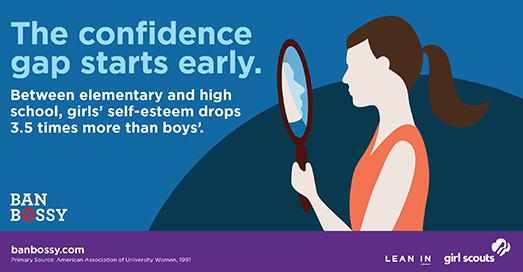
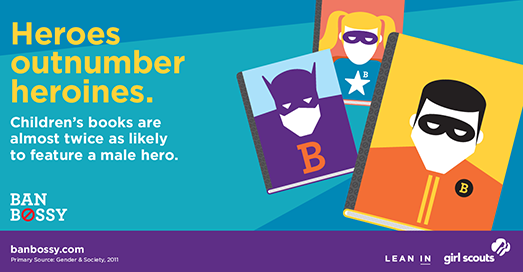
The following pictures include some points of their arguments: 


Michelle Obama supports this campaign. The First Lady's Instagram, michelleobama, shows this picture below and says the following: "Commit to your education, because every time you stretch your mind, you boost your confidence and add power and credibility to your voice—The First Lady encouraging girls to lead #BanBossy."


The Ban Bossy video was uploaded on 9 March 2014. I waited a few weeks to see what some responses were.

It has received over two million views. However, the dislikes are more than the likes. Why is that?

To my surprise, the majority of comments were made by men (or were at least using usernames that are usually associated with men, such as John or Paul). Unfortunately, YouTube users have made some offensive and startling remarks.

Here are a few comments made in the last 24 hours on YouTube.

  • Paul McGuire wrote, "I hate it when women try to sound intelligent when they have much smaller brains than men."
  • Darragh Tate wrote, "Actually, now that I think of it, of all the words they could start a campaign to ban, they go with bossy?" He then listed several offensive, derogative words and continued, "these are all a-okay, but bossy? Unacceptable! Ban it!"
  • Another user wrote, "Perhaps if your dreams are utterly destroyed by schoolyard name-calling, perhaps your rudimentary dreams are better off buried."
  • A user named Johnny wrote, "Isn't it ironic that the strong independent feminist are crushed by name calling If you crumble under the heat you probably shouldn't be in a position with power.
  • Dingo Egret (sarcastically?) wrote, "Criticizing campaigns to ban non profane words from the english language is practically rape! I'm going to tumblr now to cry about my entitlements and the PATRIARCHY."
These comments are offensive and narrow-minded. A few, quick thoughts on the comments listed above:

  • These women are intelligent and strong leaders or role models for countless numbers of people (both male and female).
  • Trying to "ban" a specific word is probably impossible. People can teach and preach about not using swear words, but let's be real—swear words have probably been used since the beginning of time. The point here is that labeling people is unkind. You should not call a person bossy or any other offensive term because it is exactly that—offensive. Maybe "banning" something is too idealistic, but here the focus is on the effort to change how we treat one other.
  • The dreams of these women were not destroyed. Once again, it just goes back to treating people with common curtesy. Don't be mean; don't label. Words have connotations. The point here is to encourage and lift each other up, not tear each other down.
Ummm . . . these women are not "crumbling under the heat." They are in positions of power and prominence because they have thrived, despite the labels and names people have called them. They are stronger than that. But it still doesn't make name-calling, in whatever form, okay.

Rape jokes, even went written sarcastically, are not okay. Ever. Got it?

I only saw one positive, non-offensive comment, which was written by a female user.

Amy Change stated, "How can there be so many dislikes? they make a valid point that girls who tend to be in leadership are labeled as pushy and bossy while boys are labeled as ambitious. This a culture that we live in."

I think that, once again, anonymity on the web is often a tool that is used negatively by users who hide behind their computer screens and write terrible comments to try to tear others down or reveal their most offensive thoughts. Most of the comments, especially those listed above, perhaps emerge from insecurities. 

And guess what. Sometimes girls are bossy. Sometimes boys are bossy, too. Sometimes girls are mean. Sometimes boys are mean, too. Sometimes girls are kind and happy and amazing. Sometimes boys are kind and happy and amazing, too.

Does "Ban Bossy" sound bossy to you? Is that maybe the underlying point? We label, and we judge. We gossip, and we backbite. This should and must stop. The take-away message: be careful in the language you use because you never know what effect you can have—either positively or negatively. 

See the website if you would like to learn more.


ADSENSE HERE

Irena Sendler

ADSENSE HERE

ADSENSE HERE

President's Day: The Nation's 1st First Lady, Martha Washington

ADSENSE HERE

If you would like to read more about Martha Washington, see this website.
  •  Martha was born on June 2, 1731, making her eight months older than George Washington.
  • Unlike most women in Virginia in the early 1700s, Martha learned to read and write.
  • Martha grew to be about five feet tall.
  • Martha married Daniel Parke Custis on May 15, 1750.
  • Martha gave birth to four children, all of whom she outlived.
  • Martha and George Washington were married on January 6, 1759.
  • Martha stayed at George Washington’s winter encampments throughout much of the Revolutionary War.
  • Martha was the nation’s first First Lady.
  • Martha freed George Washington’s slaves almost one year after his death.
  • Martha died on May 22, 1802 and lays in rest next to her husband.


ADSENSE HERE

Happy Anna Howard Shaw Day This Friday

ADSENSE HERE
Don't feel like celebrating Valentine's day this Friday?

Well, here's another option.

Anna Howard Shaw was born 14 February 1847.

She was pretty influential. She was
a leader in the suffrage movement in the United States, one of the first ordained female Methodist ministers in the United States, and a physician.

Celebrate the women in your life and those who changed history!  :)

(Shout out to Liz Lemon from 30 Rock!)
ADSENSE HERE

Good Media: Mary Cassatt

ADSENSE HERE
Focusing on the theme of media, I have chosen Mary Cassatt to exemplify the power of good influence in media.

I have been surrounded by art since I was very young. Fortunately my parents didn’t just let my obsession with Crayola coloring remain a toddlerhood hobby. They gave me access to resources that I realize more and more were invaluable to me becoming an artist. I grew up in the D.C. area, which introduced me to culture, history, and some of the greatest art in the world.

When I was about seven years old my second grade art teacher took us to the National Gallery. I can remember how I felt inside the airy museum and I can remember how the light flooded in through the tall ceiling roof in a calm and reverent way. It’s a place that I try to be in as often as I can, and I never regret a moment spent there. It was on that same trip that I met my first few Mary Cassatt paintings. I just liked her and all of her work. I’m sure that as a seven year-old I liked to see the girls in her paintings. They wore dresses and played on the beach and did every day stuff that I could relate to. I think she saw her world similarly to how I see mine.

From that point on Mary Cassatt stuck with me. I didn’t realize until much recently, that all of the aspects of her work that I love actually made Cassatt’s paintings quite innovative for her time period. She depicted women and families in a different light than was and is often typical; placing them in everyday scenes and capturing small moments that are often overlooked. In comparison, so many pieces of art that were created previous to Cassatt depicted figures who were stoic, grande or mythological, but she was able to create this feeling of nostalgia in her works and she gave women a real voice. She showed them as real people with personality and diversity instead of the pretty little women garbed in satin.

Mary Cassatt was an American born artist who fell in love with art when she was very young. She was determined to make a career in a difficult field where very few women were highly recognized, but to aspire to have a serious career in her time was a rarity in itself. She was able to study in France and became friends with Edgar Degas who introduced her into the society of the other Impressionist artists.

Not only did Cassatt achieve respect as a female artist, but she was an artist in an innovative and revolutionary style and is now known internationally for her art. The impressionists broke away from realism, and they began to paint the emotions and impressions of the scenes and landscapes that they saw. While there are many today who love Monet’s "Water Lilies," Degas’s dancers and Cassatt’s "La Toilette," the reaction from the art world in their time was discouraging. In Impressionists and Their Art Russell Ash says, “Works by Monet, Manet, Renior, Pissaro, and Sisley went for disastrously low prices. . . .”

Aside from the art history lesson, I really admire each of these artists, and Mary Cassatt especially, for taking on these challenges. I think that she is an amazing figure from history who shows us that we can overcome trials, we can do what we love if we try hard enough and we can make a positive impact in the world and in the media. The Impressionists not only made beautiful and uplifting works, but they also created art that changed the way people perceived the world and they opened up new ways of expression.

We can be swallowed up in media—whether it is in the salons of 19th century Paris or the television and social media of the 21st century—but we don’t have to be. We can find ways to utilize media for our benefit and we can make a difference in the media by creating new and uplifting art, stories, movies and music. We can also make a difference by simply promoting good media and not supporting the media that demeans us, not only as women but as citizens of the world. If our great predecessors like Mary Cassatt can do it, so can we!

Article and Illustration by Normandie Luscher

ADSENSE HERE

Empowering Costumes for Women

ADSENSE HERE
As Halloween approaches, the pressure increases to find a fabulous costume. Even if you're not trick-or-treating, this holiday provides plenty of opportunities to dress up. I have been thinking of powerful female characters to dress up as this year, myself, and I came up with a list of five of my favorite ideas.
  • Hermione Granger represents intelligence, loyalty, and empathy. She deconstructs prejudice against her gender and her background by performing to the best of her abilities at all times.
    • To dress up like Hermione, don a gray pleated skirt, a gray sweater and white collared shirt, and a red and gold tie. Carry around a stick for a wand. If you can get hold of a black robe, put that on as well!
  • Molly Weasley stands for nurturing and motherhood. Some may consider her frumpy and sheltered as a stay-at-home mom, but she made her choice to stay home and she adores her family. And yet she has powerful magical abilities which are not hindered by such a choice.
    • Dye your hair red if it isn't already, or put on a wig. You may want to curl it and tease it out. Actual clothes do not matter so much, as long as they're mismatched and look pretty like they've come from a thrift shop. If you aren't as plump as she is, consider some stuffing or a pillow to put under your shirt.
  • Tiana demonstrates ingenuity and resourcefulness in the face of peril. She does not expect anything to fall into her lap. Rather, she works hard for all she gets and she holds high ambitions!
    • You've got a couple of choices—dress up like a frog wearing a skirt or try to imitate her gorgeous green gown at the end. Make sure you add a tiara and gloves!
  • Katniss Everdeen symbolizes strength and a grounded outlook on life. Despite immense trials, she maintains an admirable calmness. She does what she must to survive and yet she also retains her sense of morality.
    • Again, this character provides a few options. You could wear her Hunger Games getup (black jumpsuit or tracksuit with a backpack and arrows, or something like that) or you could find a dress that looks like it's on fire.
  • Wendy Darling treasures childhood and adventure, but she learns to grow up and move forward in life. Although initially all she wants to do is stay young, she quickly recognizes the need to progress and she acts on that realization.
    • This costume is probably the easiest out of the five. Find a light blue nightgown and slippers and tie your hair back with a ribbon!
Who would you dress up as if you had to pick an inspiring female figure, and why? Who do you admire? What messages do you think we should send to others about the kind of people we should be emulating? What messages have some of your costumes in the past sent to others, consciously or not? It's something I never thought about much before, but it's interesting and important to consider.

Kelsey Allan is a senior studying English and editing.
ADSENSE HERE

A Voice for Courage: Sophie Scholl

ADSENSE HERE
It can be tough to talk about some of the serious and real issues that are discussed on this blog. I know that for me, it can be empowering and invigorating to study about what is going on in the world and to find ways to contribute and help, however it can also be information overload, or just disheartening. However, I find it helpful to look at the humble giants throughout history who have accomplished great things despite their circumstances and challenges.

To finish up my posts about human trafficking and slavery, I wanted to talk a little bit about one of my favorite heroines, Sophie Scholl. This girl was so incredible. Sophie lived in Germany during the reign of the Nazi Socialist party. She and her brother and other peers were students at the University of Munich who started the non-violent anti Nazi revolutionary group that they called the ‘White Rose’. They had a few reasons for the name, but the one that sticks out to me is that the white rose symbolizes purity and innocence in the face of evil.

Their situation was different than ours is today; however, they were still motivated by the same principles of love, freedom and peace for all people that motivates us as disciples of Christ. The girls that I have been talking about in my posts in regards to human trafficking are oppressed in different ways, but however different their circumstances, they still need freedom. They need someone to fight for them. They need voices of courage to speak for them.

Sophie and the other members of the White Rose boldly spoke out against that terrifying regime. They were so passionate about the rights and freedom for their people that they wrote out their philosophies and pleadings to their fellow Germans and then distributed them on leaflets and left them anonymously throughout the campus.

Can you imagine the courage that it would take to speak out against the Nazi party? The Nazis were ruthless, but these students knew and understood the value of truth, the worth of freedom and the worth of each soul. They knew that it was worth sacrificing for and Sophie and many other members of the White Rose became martyrs for their cause.

The victims of the Holocaust were ripped from their homes and dehumanized, their possessions were taken from them, and they were brutally killed. The victims of human trafficking are similarly often ripped from their homes and societies, dehumanized and brutally abused. They face terrible atrocities and as Mormon wrote, they are [deprived] . . . of that which [is] most dear and precious above all things, which is chastity and virtue’ (Moroni 9:9).

Thank goodness for that passion for freedom that has driven countless people to crusade and fight for liberty and safety and to fight against the opposition of purity and innocence. Thank goodness for people like Sophie Scholl and those of the White Rose who put every ounce of effort that they had into spreading the message of truth.

One of the Women’s Services and Resource Center’s themes right now is "Be a Voice of Courage." We may not need to sacrifice our lives for the causes that we feel passionate about, but even if you are only one person, your voice is valuable and you can make a difference through your actions and most especially with your words. Be a voice of courage and take a stand for freedom, whether it is in your broader community or within your own home.

Another way that you can participate in the Voice of Courage Campaign is to run with us October 19th at the Voices of Courage 5K. The run will start at 8:30 am at the RB Quad.

Also, another P.S. There is a great movie screening next week on campus that talks about these important women’s issues and helping women to become free all around the world. If you would like to see this film, Half the Sky, I definitely encourage you to go! It will play in two parts: the first half will be played October 2nd and the second half will be shown on the 3rd. It will be in room 238 in the HRCB. Join the Facebook group here.
ADSENSE HERE

"Jesus Is A Feminist"

ADSENSE HERE
“Jesus is a feminist.” My Relief Society sister said this to me as a matter of assured fact and with obvious enthusiasm.


I thought for a moment about how the general public would react to that statement. I remembered moments when I had stated that I myself was a feminist. I typically received reactions ranging between two extremes. One was that I was praised for shunning my patriarchal oppressors who expected me to only become a lowly housewife, locked inside of some 1950s sitcom. The other reaction brought an onslaught of raised eyebrows and quizzical looks that suggested that I must be apostatizing from the Church. Sometimes I received small bursts of negativism and a prompt change of subject.


Some of these reactions startled me a bit, but I think more importantly, they motivated me to ask honest and sincere questions. I realized that when I explained what I thought and felt about women’s issues, others didn’t always agree that what I talked about was defined as feminism. So my first question, however basic, was "What is feminism?"


I noticed that there was a vast difference of opinion from not only members and nonmembers of the Church, and male or female, but it also was significant to note my environment.
There are many girls on BYU campus who are very passionate about women’s rights and equality and they proudly share their title of "feminist." I realized that most of them looked at the term in a vast sense of simply “supporting women,” which is close to how I originally defined the word. When I interned in Washington, D.C. however, people assumed that I, as a self-proclaimed feminist, was pro-abortion, a supporter of sexual freedom, and a power-hungry man-hater . . . or something like that!


I’ve come to realize that "feminism" is one of those incredibly loaded words that means something very different to each person. Some take a self-assumed definition which, as it does in most cases, causes greater confusion, contention and places distance between parties.


Since I have started claiming that I’m a feminist, I’ve decided to do some more research to try and understand within several contexts, what it is exactly that I am trying to say (a smart idea in any case, right?!).


First, for a little debrief on the history of feminism. There have been several "waves" of feminism that have each tried to accomplish different objectives.


1st wave: The first wave of feminism encompasses the initial forms of freedom for women in regards to politics and voting rights with the women’s suffrage movement.


2nd wave: The second wave of feminism was concerned with inequality and preventing discrimination between the sexes.


3rd wave: By far the most controversial wave of feminism was the third, which sought to change stereotypes of women and social perceptions of who a woman is and what defines her.


As it goes in politics, there are conservative and liberal sides within the feminist perspective. Some women want to become the dominant gender, while others simply want to support their fellow sisters in being the best they can.


There is one point that I want to emphasize. When I was talking to one of my friends (a very politically-involved Republican in D.C.) about the term "feminism," he asked, ‘So you don’t feel that men and women are equal?’ The question caught me off guard and I doubted my own stance for a minute, but then I realized that I suppose my answer is no.

I think that the equality between women and men has come a long way in a very short amount of time. This is arguably the best time in the history of the world as far as gender equality is concerned. However, that does not mean that there is freedom for every person. Some forms of oppression are very directly tied to women and there are several specific points that cause women’s issues to remain extremely relevant.  


These are four issues that I think take precedence, and I plan to write about them in later posts:


Educating Women
Human Trafficking, Sex Slavery, and Genital Mutilation
Women in Media
Self-Esteem, Emotion & Depression, and Perfectionism


There are a myriad of issues that pertain to and directly affect women. I feel that when loaded terms and phrases such as "feminism" and "gender equality" are thrown around, the uproar that the words cause end up overshadowing what the words actually indicate.


Those who say that feminism is utterly absurd typically feel that feminists are too aggressive and will jump down their throats in a discussion, and therefore it’s not worth the time to engage with them. I’ve also experienced many times those same people rolling their eyes and not taking much time to listen, even when an attempt is made to be extremely civil in discussion. While there have been several extreme groups throughout history and there are still extremists today, those extreme groups are not necessarily inclusive of every perspective.


What I fear is that when feminism is dismissed or pushed under the rug, these pressing issues are swept away with them. If we never take the time to discuss and learn about the real plights of women, we will never take action against the reality of oppression.


When we run from these issues are we not "going away also" as the Savior indicated to His disciples in John 6:67? I believe that there is a great work for us to do, and that as daughters in His Kingdom, God has endowed us with the power and responsibility to face that work. I believe that the second most important message of the Gospel of Jesus Christ, after the Atonement, is the principle of freedom. John Green, my favorite historian, writer/philosopher, and advocate of empathy said, "Try to remember that the world isn’t just, because only then will we have the power to change it." Recognizing that there is room for improvement does not degrade what we have already accomplished. It is striving for Zion, which I think we could all do a little better at.


What I really think feminism is, is embracing freedom for women and treating women--including ourselves and other women around us--with dignity. While some may view feminists as radicals who only glorify women in the work field, I think that feminism cannot be all encompassing until the role of a mother is included in the empowerment of women. Mothers are leaders in their homes and in their communities. As quoted by Kid President, “The secret to changing the world? Moms”.


So would Christ be a feminist? To me He is. To me, He is the greatest supporter of women, but it depends on how we look at the word. So how will we define it? What does it mean to us? While a new wave is not necessarily in order, is a new word in order? The concept of feminism itself is still very new and in some ways fragile and I think we will only know when we take the time and the thought and the research to find out and to decide together as a community of women, men, citizens and saints.
I will go more in depth in future blog posts, but I would love to hear your thoughts and questions. Let me know in the comments below!

Article and Illustration by: Normandie Luscher
ADSENSE HERE

Herstory: Malala Yousafzai

ADSENSE HERE
The story of this young girl inspires me so much that she deserves her own Herstory blog.

Malala was born in Pakistan in 1997. In the Swat Valley, where Malala lived, the Taliban banned girls from going to school and Malala became an education and women's rights activist. When she was 11 years old, she anonymously wrote a blog for the BBC detailing what her life was like under Taliban rule. The next year, a documentary was filmed about her life and she rose in popularity, giving interviews and becoming the youngest person to ever be nominated for a Nobel Peace Prize.

On October 9, 2012, Taliban gunmen boarded the bus that Malala was riding home from school and demanded to know which girl was her, threatening to shoot everyone if she didn't identify herself. When she did, they shot her in the head. The bullet went through her head and neck and lodged in her shoulder. She was taken to a military hospital and remained unconscious and in critical condition until she was well enough to be flown to a hospital in the United Kingdom.  Miraculously, Malala survived and has completely recovered with little to no brain damage.

Following the assassination attempt, a United Nations petition was launched in her name, demanding that all children worldwide have access to education as a basic human right. She also was named one of Time Magazines 100 Most Influential People in the World. After repeated threats from the Taliban to continue to seek her life, Malala and her family have had to stay in the United Kingdom; it is too dangerous for them to ever return to Pakistan. She spoke to the United Nations earlier today for the first time since the Taliban tried to kill her. Her message continues to be compulsory education for all children across the globe, regardless of gender.

United Nations Secretary-General Ban Ki-moon, left, applauds as Malala Yousafzai, right, addresses the ‘Malala Day’ Youth Assembly, Friday, July 12, 2013 at United Nations headquarters. Malala Yousafzai, the Pakistani teenager shot by the Taliban for promoting education for girls, celebrated her 16th birthday on Friday addressing the United Nations. The U.N. has declared July 12 "Malala Day," to honor the teen who returned to school in March after medical treatment in Britain for injuries suffered in the October attack. (AP Photo/Mary Altaffer)
"Let us pick up our books and pens. They are our most powerful weapons. One child, one teacher, one pen and one book can change the world. Education is the only solution." —Malala Yousafzai

Today is Malala's 16th birthday. Happy birthday, Malala. Your bravery inspires us.


ADSENSE HERE

You're My Shero!

ADSENSE HERE
I was talking to an old friend the other day, catching up with each other on where our lives have lead us. I told her that I'm a therapist and that I specialize in working with women, body image, and self-esteem and that I also work at Women's Services.

"Oh yeah! I read that blog. I love how passionate you are about women's issues. You're like a chick-crusader. Carly, you're my shero," she laughed.

I don't think I've ever received a better, or funnier, compliment than that.  And it really got me thinking . . . Which got me talking . . . Which got me typing . . .

We all have amazing women in our lives that inspire us by what they do and who they are. So, we want to hear about them! We are having an essay contest because we want to hear about your Shero. See the details below:

Sheroes Essay Contest
Do you know an amazing, talented, intelligent, unique, all around wonderful woman; someone who inspires you and touches the lives of everyone she meets? We want to hear about her! The Sheroes Essay Contest is a chance for you to write a short essay about an amazing woman you know personally. Detail what makes her your hero, how she touches the lives of others, and what you (and others) can learn from her about being an inspirational woman.

Official Rules 
Essay should be no more than 1,000 words (not including the title of the essay).
Essays will be judged based on both style and content.
Essays should be clear, articulate, and logically organized.
Proper grammar, spelling, and punctuation will contribute to the selection of the winner.
Essays will be judged in such a way that each author is anonymous to the judges (the Staff members of BYU Women’s Services and Resources).
Essays must be written in Microsoft Word, using Times New Roman or Calibri, 11–12 point font, and be double spaced.
Each essay must include a cover page with the following information
The title of the essay
Your full name (this is the only place your name should appear—do not put your name on subsequent pages)
Your email address
Your phone number
Include a running head with the title of your essay on all pages.
All students, faculty, staff, and members of the community are eligible to submit an essay.
Entrants may submit multiple entries (each written about a different woman) but will only be eligible for one prize.
Submissions will be accepted beginning July 10, 2013 and will no longer be accepted after August 1, 2013.
Submissions should be emailed to carly.lebaron@byu.edu.  Include the following in the email submission as attachments:
The essay, including cover page.
An appropriate .jpg photo of the woman written about in your essay.
When you submit a photo, you certify that you have the rights to that photo or have received permission from the owner to submit it and agree to allow Women’s Services and Resources to publish that photo to our website or other publications.
Winners will be selected and contacted on or before August 15, 2013.
Winners will be contacted using the email address and phone number provided on their cover page. If we are unable to contact a winner after one week of attempts, their prize will be forfeited and passed on to the next eligible entrant.
Winners will be responsible for claiming their prize in person at Women’s Services and Resources, 3326 Wilkinson Student Center, Brigham Young University.
Any prizes not claimed within 10 business days of notification will be forfeited.
Winning entries and notable runners-up will be posted on Women’s Services social media websites (including, but not limited to, blogs, Facebook, Twitter, Pinterest) and may be published in other forms of media (including, but not limited to, the Real Woman magazine).

Prizes
1stPlace: $25 gift card to BYU Bookstore, Women’s Services tote, and a Beautiful t-shirt (your choice of color)
2ndPlace: $15 gift card to BYU Bookstore, Women’s Services tote, and a Beautiful t-shirt (your choice of color)
3rdPlace: $10 gift card to BYU Bookstore, Women’s Services tote, and a Beautiful t-shirt (your choice of color)

Each winner will also receive a “Beautiful” t-shirt to give to the woman who inspired her essay.
ADSENSE HERE